All posts by modiji_admin

PM Narendra Modi flags an 8-foot idea for nationalism

Prime Minister Narendra Modi on Tuesday proposed that the party should take out Tiranga Yatras across the country to evoke “nationalism and patriotism” — two slogans that have rallied its supporters in recent months. The yatras will be held for a week, starting Independence Day.

Party sources said Modi, who addressed the BJP Parliamentary Party meeting on the second day of the monsoon session of Parliament, gave a detailed brief on how the yatra should be carried out. “He said MPs and MLAs should set out on bikes carrying the Tricolour, which should be at least 8 feet high, so that it evokes feelings of patriotism and nationalism among people, especially the youth. He specifically told us that we should also wear a helmet, which too should preferably have the Tricolour on it,” a BJP MP told The Indian Express.

No Loan for This Kanpur Resident Despite PM’s Recommendations

Kanpur: A carpenter in Kanpur claims to be running from pillar to post to get a loan sanctioned under Prime Minister Employment Generation Programme (PMEGP) in spite of the Prime Minister’s personal recommendations.

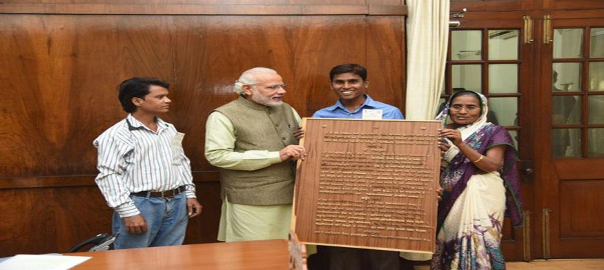
Sandeep Soni, a resident of Barra area, claims it took him three-and-a-half years to inscribe all the 18 episodes and 706 shlokas of Bhagavad Gita on 32 wooden sheets.

He claims on March 8, he had shown his work to Prime Minister Narendra Modi who had not only praised it but also uploaded his photo with Sandip on Twitter.

The Prime Minister had also assured to help Sandip who told him of his wish to start a factory where he would train unemployed youth in the craft, claims the carpenter.

Subsequently, he met an official at the Prime Minister’s Office who explained the procedure of obtaining loans under PMEGP.

Five days later, he got a call from a National Small Industries Corporation (NSIC) official in Kanpur who asked him to prepare a project report.

On July 14, the bank sanctioned a loan of Rs 25 lakh to him but there was no mention of PMEGP on the document. As a result, NSIC officials refused to grant him the subsidy, claims Sandip.

When contacted, NSIC officials said the bank was the authority concerned. Bank officials said they were looking into the matter.

Have nothing to hide on Kashmir issue: PM Modi at NDA meeting

NEW DELHI: Under opposition attack over the unrest in the Kashmir valley, Prime Minister Narendra Modi on Monday said his government has nothing to hide and would take everybody into confidence while dealing with it.

He made these remarks at a meeting of the NDA constituents which was preceded by a meet of the BJP parliamentary party executive where he said the government will talk to all parties on the GST bill and seek to build a consensus for its passage.

Shiv Sena leader Sanjay Raut told reporters that Modi touched upon the issue of ongoing unrest in Kashmir and sought views of the BJP allies.

“He said that the government had nothing to hide over the matter and it will take everybody into confidence,” Raut said.

The Sena leader said he asked the Prime Minister to hold “chai pe charcha” (talk over tea) with the people of Kashmir. He said the people did not like his ‘chai pe charcha’ with Pakistan Prime Minister Nawaz Sharif even though his intentions may have been good.

Sena has had uneasy ties with the BJP and has often attacked the Modi government over a host of issues.

Information and Broadcasting Minister M Venkaiah Naidu told reporters that Modi explained to the NDA leaders the importance of the GST bill and the need to pass it.

“All parties (of NDA) are together on the GST bill. The PM explained to them its importance and the need to pass it,” he said.

The government had made similar points the all-party meet on Sunday.

Parliament’s Monsoon Session Begins Today, PM Narendra Modi Appeals For GST Bill

NEW DELHI: As sparks are set to fly in the Parliament over a range of issues, the bill for the introduction ofGoods and Services Tax (GST) across the country remains a priority. The Government has listed around a dozen bills pending introduction, consideration and passage during the monsoon session of Parliament, starting today.
Two bills are pending passage in the Lok Sabha, while seven bills are pending in the Rajya Sabha, including the GST Bill.

At an all-party meeting convened by the government on Sunday, a day before Parliament meets, Prime Minister Narendra Modi said, “GST is of national importance. Issue is not which government gets credit. Important Bills, including GST will be taken up in the monsoon session and I hope for meaningful discussions and outcomes.”

He urged all the political parties to keep national interests above any other considerations. “We represent both the people and parties and there is a need to keep national interests above anything else”.

The Congress said it will support bills but based on merit, offering no assurance on the GST, saying it will take a stand only after the government gives it a “written draft” over concerns raised by it.

With the continuing protests in Kashmir following the killing of Hizbul Mujahideen commander Burhan Wani expected to generate heat in Parliament, PM Modi commended political parties for speaking in “one voice” over the issue.

“Various parties have given statements on Kashmir events which benefitted the country. This has sent a right message and I thank all the parties for the same,” he said.

The Leader of the Opposition in the Rajya Sabha Ghulam Nabi Azad said there should be a discussion in the Parliament on the tense situation in Kashmir and that government should provide an anwser.

The government’s unsuccessful NSG bid, floods in some states, agrarian crisis and terrorism were among the other main issues raised by opposition leaders at the meeting.

The last few sessions of Parliament have seen frequent face-offs between the ruling and the opposition benches but the second part of the Budget Session saw a relative improvement as far as the completion of government business was concerned.

In PM Modi’s Room Today, Arvind Kejriwal, Other Upset Chief Ministers

NEW DELHI: Prime Minister Narendra Modi is today meeting the country’s 31 Chief Ministers, which will put him in the same room with leaders who accuse his government of recently acting like a wrecking ball for them.

Among them is Delhi Chief Minister Arvind Kejriwal who has taken Mr Modi’s government to court for trying to appropriate the administration of the capital, and Harish Rawat, who was reinstated as Chief Minister of Uttarakhand by the Supreme Court which found that Mr Modi’s government had illegally imposed direct or President’s Rule in the hill state to get rid of the Congress government.

Sources say PM Modi is keen to exhibit his commitment to the cooperative federalism he speaks of so often – empowering state governments. Those stated relationship goals notwithstanding, the conclave will unfold in Delhi as Nabam Tuki of the Congress is meant to take a trust vote in Arunachal Pradesh to determine if he can remain Chief Minister of the north eastern state. On Wednesday, the Supreme Court said that like in Uttarakhand, the Centre had wrongly put Arunachal under President’s Rule in January.

Mr Tuki is expected to have a tough time in proving his right to remain in power – several Congressmen have broken away from the party in a large revolt.

The crisis gives opposition Chief Ministers the opportunity to allege that undermining non-BJP governments has become the natural order for the Centre. “If the Tuki government wins, then the opposition Chief Ministers will use the meet to attack the Centre. And ditto if it loses the vote,” said a BJP leader, who asked not to be named, and predicted a tense session.

The meeting today is the first in ten years of India’s Inter-State Council. Set up in 1990, the group brings together the PM, six of his cabinet ministers, and all Chief Ministers and administrators of union territories to discuss the coordination of schemes and policies.

Sources say BJP Chief Ministers will be told that if the opposition tries to swerve the meeting towards recent Centre-vs-state conflicts, they need to rally together to ensure the session does not digress from the Centre’s agenda. The PM reportedly wants to highlight the achievements of the Aadhar scheme, which has created the world’s largest biometric data base, and transfers cash subsidies directly to poor families, preventing money from being siphoned in huge welfare reform schemes.

The PM is likely to seek the Chief Ministers’ feedback and support for the crucial Goods and Services Tax or GST, a landmark tax reform, that the government wants to clear in the 20 sitting monsoon session that begins on Monday.

The GST, a national sales tax, will replace an unwieldy set of central and state tariffs and will, according to Finance Minister Arun Jaitley, boost the rate of growth by 2 percent. Though the proposal has been cleared by the Lok Sabha, where the government dominates, it has been stalled in the Rajya Sabha by the opposition Congress.

After Arunachal Pradesh debacle, PM Modi must abolish post of governor

If the Narendra Modi government wants to show some contrition for using the governor’s office to destabilise governments in Uttarakhand and Arunachal, it has a simple option: Abolish the post.

Send the oldies who occupy Governor Houses back to their families to spend the rest of their retired lives without being a burden on the Indian exchequer. Put the sprawling properties they occupy to some productive use, throw open their gardens for morning walks, yoga and children to play.

The Supreme Court verdict on Arunachal Pradesh is the perfect opportunity to reconsider the rationale of appointing governors. For years the Centre had used the Governor House to meddle in the affairs of democratically-elected governments. Since the days of Indira Gandhi, many Governors have been accused of being the Centre’s spies, musclemen and agents.

But, after the Arunachal Pradesh verdict, it is clear that the days of governors using their discretion to destabilise governments is over.

“The governor must remain aloof from any disagreement, discord, disharmony, discontent or dissension, within individual political parties,” a five-judge Constitution bench said while restoring the Congress government in Arunachal Pradesh.

“The governor must keep clear of any political horse-trading, and even unsavoury political manipulations, irrespective of the degree of their ethical repulsiveness. Who should or should not be a leader of a political party, is a political question, to be dealt with and resolved privately by the political party itself. The governor cannot make such issues a matter of his concern,” the court said.

So, how does the Centre now benefit from retaining governors who have been stripped off their powers to keep rival parties in check? Deprived of their ability to destabilise governments, they would be of little use to Delhi.

The governor’s post is largely a ceremonial one. In public opinion, a governor is linked with Republic Day pageantry and government-dictated addresses to the Assembly when their sessions are reconvened. Sometimes, they ask the government to reconsider some bills. But their advice is not binding. None of this makes the governor indispensable.

The governor gets some importance also when new governments are to be formed or sworn in. Till a few years ago, in the event of a hung assembly, the powers vested in him left some scope for manipulation. But, now the procedure has been well laid out–single largest party or pre-poll alliance gets the first shot. So, the Governor has no discretionary powers. And, do we really need to spend so much just to have someone who can administer oath of office and secrecy to a CM and his team? Since the chief justice of a high court is also empowered to do that, why not let him perform this ceremonial duty?

If the dispensability of Governor’s role is not a compelling factor, think of Narayan Dutt Tiwari, JP Rajkhowa and Ram Naresh, three retirees who brought disrepute and charges of impropriety to the office.

A few years ago, Tiwari was caught on camera in the company of young women, playing out his perverse fantasies in the Raj Bhavan. His shameful conduct had triggered calls for abolishing the post, but the UPA could not muster the courage for it.

But, Rajkhowa’s conduct must.

The Arunachal Pradesh governor turned into the butt of jokes when he passed on fiction and fantasies as the rationale behind dismissing the Congress government. One of his arguments was that there could be unrest because of slaughter of ”cows” in the streets of Arunachal Pradesh, a crime he claimed to have witnessed.

It showed Rajkhowa’s complete lack of knowledge of the customs of the state he was governing. In Arunachal Pradesh, it is customary for people to slaughter ”Mithunas”, a bovine species Rajkhowa confused with gau mata and raised an alarm.

Then there is the strange case of Madhya Pradesh governor Ram Naresh Yadav, a Congress appointee who has mysteriously hung on in the Modi government in spite of facing serious allegations in connection with the Vyapam recruitment probe.

In its recommendations to the government, the Sarkaria Commission had suggested sweeping reforms in the appointment of governors. It had suggested that only eminent persons who have stayed away from active politics for a long period be appointed in consultation with the chief minister of the state, Vice-President of India and the Speaker of the Lok Sabha.

But, no government bothered to implement the reforms. Every party in power at the Centre used it as a reward for loyalists, stooges or as a ruse for shielding them from legal proceedings — case in point, Sheila Dikshit, who was sent to Raj Bhavan soon after losing the 2013 Assembly polls amidst charges of corruption.

Had the recommendations been accepted, the governor’s office may have retained some of its legitimacy and credibility.

PM Modi rejects Smriti Irani’s choice of CBSE chief, HRD to have no say

A week after moving out Smriti Irani from the Ministry of Human Resource Development, Prime Minister Narendra Modi has rejected her selection of the chairman of the Central Board of Secondary Education (CBSE) and taken the entire process out of the ministry’s realm.

The Appointments Committee of the Cabinet (ACC), of which the Prime Minister is the deciding authority, rejected the name of Dr Sarvendra Vikram Bahadur Singh as the next CBSE chief.

A letter received by the HRD Ministry Tuesday from the Department of Personnel & Training (DoPT) stated: “While considering the proposal, the competent authority in the ACC has conveyed that the post be filled under Central Staffing Scheme (CSS) by keeping the recruitment rules in abeyance.”

Kashmir violence: Hours after landing from Africa, PM Modi chairs meeting to review situation

Prime Minister Narendra Modi chaired a high-level meeting to take stock of the on-going violence in Kashmir. The Prime Minister returned early this morning after concluding his four-nation Africa tour aimed at enhancing ties with the continent. Home Minister Rajnath Singh, meanwhile, has cancelled his visit to the United States in view of the on-going situation. He was to attend the Indo-US Homeland Security Dialogue.

The meeting was attended by senior members of the cabinet including Home Minister Rajnath Singh, Finance Minister Arun Jaitley External Affairs MinisterSushma Swaraj and Defence Minister Manohar Parrikar among others.

In Nairobi, PM Modi Talks Economy, Goals For Common Man

NAIROBI, KENYA:  Prime Minister Narendra Modi arrived in Kenya to a warm reception by the Indian community in Nairobi, where he spoke of his government’s achievements and the significance of Africa. PM Modi said the main goal of his government was to improve the life of the common Indian man.
Here are the latest developments:
  1. “India is not a selfish nation. We believe in Vasudhaiva Kutumbakam (world as one family),” PM Modi said to a thunderous applause. “Africa is very vital for India. Our journeys have been shared. India has never thought only about itself,” he said.
  2. The Prime Minister said despite two consecutive droughts, his government has delivered a growth rate of 7.6 per cent. “But we won’t stop here, we have to attain 8 per cent,” he said, adding, “People in the world today look at India in a way which makes us Indians feel proud”.
  3. The Prime Minister said that he was mocked when he spoke of building toilets from the Red Fort. “They asked why the PM is talking about something so small. For years people have talked big from the Red Fort. I changed everything. I spoke about the common man,” he said.
  4. PM Modi was in Kenya for the final leg of his four-nation Africa tour. In Tanzania, he played the traditional drums with President Magufuli and said the country was a “crucial partner”. The two sides signed an agreement under which India will provide a Line of Credit of $92 million for rehabilitation and improvement of Zanzibar’s water supply system. They also signed agreements on visa waiver for diplomatic/official passport holders.
  5. “Being neighbours across the Indian Ocean, (Tanzanian) President (John Magufuli) and I agreed to deepen our defence and security partnership, especially in the maritime domain,” PM Modi said in a joint press statement with Mr Magufuli.
  6. He also met with a group of “Solar Mamas”, women from developing nations who have been trained in harnessing solar energy at the Barefoot College at Tilonia village in Ajmer, Rajasthan.
  7. On Saturday, PM Modi addressed the Indian community at the reception hosted by the Mayor of Durban and the Indian High Commissioner to South Africa. Speaking of what India and South Africa have in common, he said that it would be a ‘”No Ball, if I don’t talk about cricket in Durban”, adding, “The passion and love for this game runs deep in our societies.”
  8. PM Modi, on the second day of his engagements in South Africa, boarded a train from Pentrich Railway Station to Pietermaritzburg in memory of the 1893 incident in which Mahatma Gandhi was thrown out of a train compartment because of his skin colour.
  9. Earlier on Friday, after arriving in Pretoria, he held talks with South Africa President Jacob Zuma and addressed a meeting of business leaders. In the evening, he addressed more than 11,000 members of the Indian community in Johannesburg calling the country the ‘karma-bhoomi’ of Mahatma Gandhi.
  10. PM Modi’s first stop was Mozambique, where India handed over 30 Mahindra SUVs to the government, completing the delivery of $4.5 million grant assistance as part of supporting institutions in the African country. The prime minister will leave for New Delhi today.

India working to achieve 8 p.c. growth: Modi

Narendra Modi said his government is working in a campaign mode to create 500 million new jobs by 2022.

India is working to achieve over 8 per cent growth in the coming years, Prime Minister Narendra Modi said in Johannesburg on Friday, while attributing the rise of the country to HOPE — Harmony, Optimism, Potential and Energy.

He told the Indian diaspora that India is “one of the brightest spot in the global economy” and a “land of opportunities” for those who want to invest and have trade.

Mr. Modi said his government is working in a campaign mode to create 500 million new jobs by 2022 besides transforming rural and urban areas of the country through infrastructure development.

“While the world is marked by slowdown, India has registered a growth of 7.6 per cent this year and we are working to grow even at 8 per cent in the years ahead,” he said addressing an estimated gathering of 11,000 members of the Indian diaspora.

Mr. Modi, wearing a ‘Madiba’ shirt identified with anti-apartheid icon Nelson Mandela, said India’s dynamism is not about mere words but it is driven by concrete action.

“It (dynamism) is defined by our commitment to change the face of the Indian economy. Not just through sustained rapid economic growth but through multiple transformations that aim to uplift,” the Prime Minister said.

“India’s rise can be defined as HOPE — Harmony, Optimism, Potential and Energy….India’s rise is a story of rare resilience, renewed resurgence, superb speed and spectacular scale,” he said in his 40-minute address.

He said his government wants enterprises to flourish, businesses to grow and the country to rise. “For this, we are already shaping a policy framework that strengthens India’s ability to build trade, manufacturing, innovation and investment partnerships with other countries in the world,” he added.

Mr. Modi said his intent was to ensure that the 800 million youth of India should fulfill the dreams, not only of India but the global demand.

“It is not only the economy or society that is racing ahead but the mindsets are also changing,” he said while giving an overview to the audience about the developments in India which he wanted them to see for themselves.

Seeking to strike a chord, Modi said as South Africa works for its economic prosperity, safety and security, it will find in India a “trusted and reliable partner“.

He said both India and South Africa face similar challenges and India is ready to join this country in its endavours.

“India and South Africa are strategic partners. We should build a partnership that spans entirety of human endeavour,” the Prime Minister said.

He said while terrorism is a global challenge, fight against diseases like AIDS and Ebola are some of the other priorities.

The Prime Minister noted that South Africa was the place where Mahatma Gandhi “conceptualised his politics” and is the “birthplace of Satyagraha”.

Describing South Africa as “karambhoomi (land of work)” of Mahatma Gandhi, he said this country “transformed Mohandas into Mahatma”.

He said Mahatma Gandhi held South Africa dearly as he believed that he had got rebirth in this land.

Hailing the Indian diaspora in South Africa as “proud sons and daughters of Indian heritage”, he said several Indians had gone to jail with Mandela and sacrificed their lives in the fight against apartheid.

Mr. Modi said while India was in the lead in opposing apartheid and had boycotted South Africa during those days, it was the first to embrace the country after apartheid was over.

In this context, he noted that India had hosted the South African cricket team a few months after apartheid was lifted on July 10, 1991.