All posts by modiji_admin

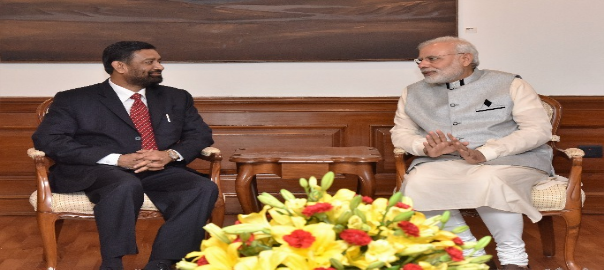
Mr. Bimalendra Nidhi, Deputy Prime Minister and Minister of Home Affairs of Nepal calls on PM

Mr. Bimalendra Nidhi, Deputy Prime Minister and Minister of Home Affairs of Nepal called on Prime Minister Shri Narendra Modi today.

The Prime Minister congratulated Mr. Bimalendra Nidhi on assuming office as the Deputy Prime Minister and Minister of Home Affairs of Nepal. The Prime Minister also conveyed his greetings and best wishes to the new Government of Nepal, led by Prime Minister Pushpa Kamal Dahal ‘Prachanda’.
Mr. Bimalendra Nidhi briefed the Prime Minister about developments in Nepal.

Stating that the relations between India and Nepal were not merely between the two Governments, but between the people of both countries, the Prime Minister reiterated that India is committed to strengthening these traditional bonds of friendship and kinship with the people of Nepal.

The Prime Minister said that India is fully committed to support the Government and the people of Nepal in the post-earthquake reconstruction efforts.

The Prime Minister also conveyed an invitation to the Prime Minister of Nepal to visit India at his earliest convenience.

PM congratulates Sakshi Malik on winning Bronze in Rio Olympics

The Prime Minister, Shri Narendra Modi has congratulated Sakshi Malik on winning Bronze medal in Wrestling in Rio Olympics.

“Sakshi Malik creates history! Congratulations to her for the Bronze. The entire nation is rejoicing.

On this very auspicious day of Raksha Bandhan, Sakshi Malik, a daughter of India, wins a Bronze and makes all of us very proud.

Sakshi Malik will inspire several sportspersons in the years to come.”, the Prime Minister said.


Villagers in dark about why PM Narendra Modi said they have power

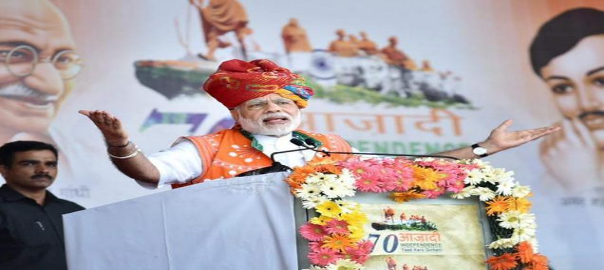
A short journey from Delhi, Prime Minister Narendra Modi said in his Independence Day address, there is a village in Hathras called Nagla Fatela. “It takes only three hours to reach Nagla Fatela. But it took 70 years for electricity to reach there.”

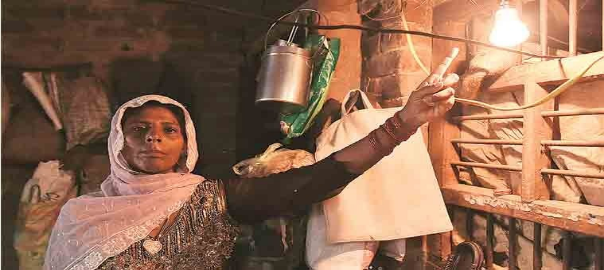
On the ground, in the village, however, this statement came as a surprise to residents, many of whom have been living without electricity.

The village has about 600 homes — 450 without power. The 150-odd homes that do get electricity rely on illegal ‘katia’ connections: they have connected their homes to a transformer meant to run 22 tubewells, and, in return, pay Rs 395 for two months to the Dakshinanchal Vidyut Vitran Nigam Limited (DVVNL), village pradhan Yogesh Kumar told The Indian Express.

“Perhaps, the Prime Minister hasn’t been made aware of the condition of our village,” said Ullanoor Usmani, a resident.

Nagla Fatela, about 300 km from New Delhi, has a population of 3,500, with about 900 registered voters. It is one of the 10,045 villages where infrastructure was provided under the Prime Minister’s rural electrification drive. According to the Ministry of Power, complete electrification of 18,475 villages will be done by May 2017.

“It’s true that the government made arrangements for electrification of our village under the Deen Dayal Upadhyay Gram Jyoti Yojana. We got poles, wires and meters but power supply remains a distant dream for us,” said pradhan Kumar.

Photos shared by the Prime Minister’s Office showing villagers watching TV on Independence Day also surprised locals. “These pictures are not of our village. The one with balloons seems to be of Nagla Sindhi, another village in Hathras which was electrified under a similar scheme,” said Devendra Singh, former pradhan of Nagla Fatela.

When contacted, V S Gangwar, Chief Engineer at DVVNL’s Aligarh division, said the village was electrified many years ago, but only through ‘katia’ connections.

“Around 150 houses have power since 1985 through the transformer meant for tubewells. We generate an electricity bill for these consumers,” said Gangwar.

Sub-divisional officer of the local power sub-station, Kayam Singh, said the power department has not been able to provide electricity to the village as they need a no-objection certificate from a private company that placed poles and wires in the village to provide power. “The private firm is yet to provide the NoC,” said Singh.

After the PM mentioned Nagla Fatela in his speech, officials of the power department, including SDO Singh, rushed to the village to check the status.

District Magistrate, Hathras, A K Singh said a team of officials had been sent to the village to verify which power connections were legal. Those using ‘katia’ will be punished, he said.

Meanwhile, the PIB today issued a clarification titled ‘Electrification of village Nagla Fatela, Hathras — facts at a glance’. It read: “Electrification of said village was proposed by the UP government under 12th plan of Deen Dayal Upadhyay Gram Jyoti Yojana and the Detailed Project Report (DPR) was submitted through a state-level steering committee, headed by the chief secretary of the state on 13.11.2013. For this village, the DPR proposed connections to all households, including creation of infrastructure…”

NEWS FLASH Two civilians killed during clashes with security forces in Jammu and Kashmir’s Budgam. 62 have died in protests in the state In PM Modi’s Independence Day Speech, Firm Words Against Pakistan

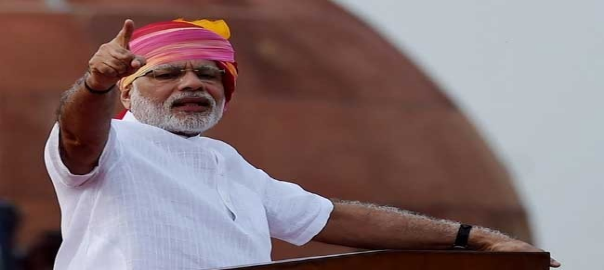
Prime Minister Narendra Modi’s speech on Independence Day made it clear that he has completely rerouted his policy on Pakistan with aggressive comments referring to Pakistan’s human rights abuses in its large province of Balochistan as well as Pakistan-Occupied Kashmir.
Mr Modi said the people of those areas have thanked him for drawing attention to their troubles, a reference to his warning last week that if Pakistan continues instigating the violence that has seared the Kashmir Valley for over a month, India will be compelled to expose Islamabad’s many wrongdoings in regions fighting terror and atrocities by its security forces.

The PM’s comments about Pakistan were placed at the end of a lengthy speech he delivered in the traditional address on August 15 from the ramparts of the Red Fort. “They glorify terrorists who attack us,” he said, recalling that India “cried with sorrow” when nearly 130 children were killed in a ruthless massacre by the Taliban in Peshawar two years ago.

In the evening, Pakistan reacted to the Prime Minister’s remarks, saying it proved “RAW (Indian intelligence agency) was fomenting trouble in Balochistan”. “India is a large country, but not automatically a great country.. PM Modi is trying to divert world attention from the tragedy in Kashmir,” read a statement from Pakistan’s foreign ministry.

Mr Modi’s third Independence Day speech as Prime Minister comes as the government is struggling to curtail the violence that erupted in the Kashmir Valley after 22-year-old terrorist Burhan Wani was killed on July 8 by security forces.

x

In recent years, Wani had emerged as a top recruiter for the Hizbul Mujahideen, the largest terror group in Kashmir. With frequent posts on Facebook that showed him in fatigues and with weapons seized from security troops, Wani leveraged the seething dissatisfaction of the youth in the state to glamorise militancy.

The daily clashes between huge mobs and security forces since then have killed nearly 60 people and left at least 5,000 injured, many of them security personnel. The curfew in Kashmir has extended over an unprecedented five weeks. India has blamed Pakistan for instigating the violence, both through terrorists sent across the border as well as its state agencies. The Pakistani government has eulogized Wani as a martyr and encouraged huge marches to protest against his killing while describing the unrest in Kashmir as “a freedom movement”.

Those developments have forced an abrupt end to the initiative taken by Mr Modi to improve relations with Pakistan. His outreach has involved an unscheduled stopover in December while returning home from Afghanistan, and phone calls to wish his Pakistani counterpart Nawaz Sharif on the Muslim festival of Eid.

Earlier this month, despite the plunging relations with Pakistan, Home Minister Rajnath Singh flew to Islamabad to attend a summit of SAARC, a regional organization with eight South Asian countries.

Mr Singh’s trip was suffused with tension. Pakistan allowed high-profile terrorists to hold protest marches near the venue of the conference, and the Pakistani premier made inciting remarks about Kashmir. The Home Minister warned Pakistan against the perils of lionizing terrorists in a speech that drew controversy over allegations that it was “blacked out” by Pakistan because it was not broadcast.

At All-Party Meeting On Kashmir, PM Modi Opens PoK Front

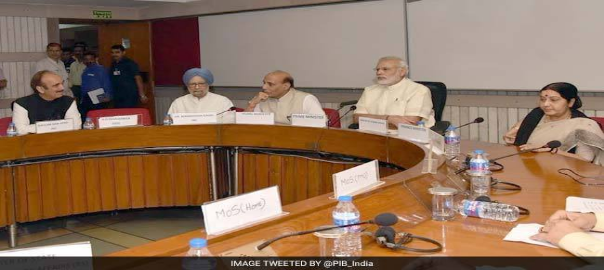
“Pakistan Occupied Kashmir is ours”,Prime Minister Narendra Modi asserted at a four-hour meeting of all major political parties today, stating that dialogue must be initiated with expatriates all over the world from that region.
“There cannot be any compromise on national security, but we have to win the confidence of the people in Jammu and Kashmir,” the Prime Minister said.

PM Modi blamed cross-border terrorism for the unrest in Kashmir and said Pakistan must also be exposed globally for atrocities in PoK and Balochistan.

He said the “foreign ministry should get in touch with expats from PoK living in various parts of the world, gather information from them on the pitiable condition in the region and let the global community know about it.”

Today’s meeting was called to find a political solution to the crisis in Kashmir, where over 50 people have been killed in clashes between protesters and security forces and more than 5000 have been injured since July 8 when violent protests erupted over the killing of Hizbul Mujahideen terrorist Burhan Wani.

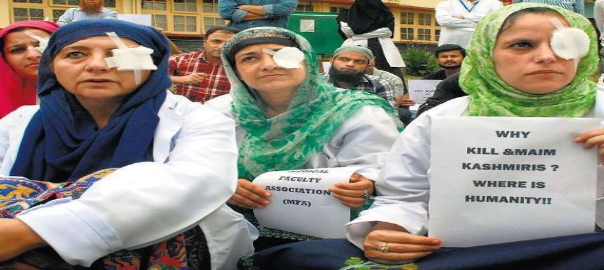
The opposition said today that it backed the government in its attempt to restore peace in the Valley, but demanded that immediate confidence building measures be initiated like discontinuing the use of pellet guns to curb protests. In the recent protests at least 100 people have been blinded by pellets fired by security forces and many others are injured.

ADVERTISEMENT

Opposition leaders also suggested that discussions be held with all groups, including separatists, and that the AFSPA or the Armed Forces (Special Powers) Act, which grants special powers to the Army, be lifted from civilian areas, which the government said conditions might not be conducive for at this time.

Former Prime Minister Manmohan Singh spoke first for the Congress, saying the “Centre must show it is a caring government.”

The government has said it would consider all of the suggestions made by the opposition, including sending an all-party delegation to Kashmir after the situation on the ground improves.

“We will be satisfied only when the ground situation improves and the government takes steps,” said the Congress’s Ghulam Nabi Azad, who had criticised PM Modi for making his first comments on the Kashmir crisis at a rally in Madhya Pradesh and not in parliament.

Modi to discuss Kashmir with all parties tomorrow

Rajya Sabha passes resolution asking people to restore peace.

Prime Minister Narendra Modi will hold talks with all political parties on Friday on the Kashmir unrest, Home Minister Rajnath Singh informed the Rajya Sabha on Wednesday.

The House also passed a unanimous resolution appealing to the people of the Kashmir Valley to restore peace and harmony, adding that there “cannot be any compromise on national security”.

Asserting that security forces were asked to show “maximum restraint” in using pellet guns against protesters, Mr. Singh was non-committal on their immediate withdrawal as demanded by several members during the eight-hour discussion on Kashmir.

On reports that Pakistan Prime Minister Nawaz Sharif had moved the United Nations for a plebiscite in Kashmir, he said: “No power on earth can snatch Kashmir from us. We will not speak to them [Pakistan] on Kashmir, we will speak to them on Pakistan-occupied Kashmir.”

He said Lashkar-e-Taiba (LeT) terrorists were issuing threats to family members of security forces and civil administration officials in the Valley. He also said slogans of “Pakistan Zindabad” would not be tolerated on Indian soil.

Leader of the Opposition Ghulam Nabi Azad sought to know from the Home Minister whether the government was going to hand over administration of the Valley to the Army after the conclusion of the Amarnath Yatra in a few days. To this, Mr. Singh said there was no question of handing over Kashmir to the Army and rumours were being spread “deliberately”. Mr. Azad also criticised the PM for his “delayed” comments on Kashmir and making those at a rally in M.P. rather than in Parliament.

“We are discussing the Kashmir issue for the fourth time. The Prime Minister should come. He chose Madhya Pradesh to speak on Kashmir. He did not come to this House. Since when has Madhya Pradesh become the capital of the country? We know that he sits in his room in Parliament from morning to evening,” Mr. Azad said.

Taking a dig at the Prime Minister, Mr. Azad said, “He tweets if something happens in Africa. Even if something happens in our enemy country, Pakistan, he issues condemnation….when the Crown of India is on fire, shouldn’t you feel the heat?”

Mr. Azad said several confidence building measures were taken during both UPA-I and UPA-II headed by former Prime Minister Manmohan Singh. Highlighting the steps taken then, the Congress said three roundtable conferences were held between February 2006 and April 2007 in which all shades of political opinion, except separatist Hurriyat Conference, participated. Five sub-groups were set up and several of their recommendations were implemented, he said.

Mr. Singh, while asserting that he was speaking on behalf of Prime Minister Narendra Modi, said that the PM was concerned at the situation and promised to consider sending an all-party delegation to Kashmir after analysing the ground situation.

Responding to demands for initiating a political process in Kashmir, Mr. Singh said the government was ready to have talks with mainstream parties, moderates and others. “We are ready. I will ask the Chief Minister where to start the process and with whom to talk,” he said.

“Whatever is happening in Kashmir is not because of the people of Kashmir. Whatever is happening is Pakistan-sponsored,” he said.

He lauded Chief Minister Mehbooba Mufti, saying she and her government had done a good job in this difficult situation.

Ramgopal Yadav of the SP sought to trace the problem to “some past mistakes” including Partition and failure to extract strong commitments from Pakistan after India’s victories in the wars of 1965 and 1971.

“A number of princely States had become a part of India under Sardar Patel but Kashmir was handled by Pt. Jawaharlal Nehru. Had Nehru waited for a few more days before going to UN Security Council when Indian forces were repulsing Pakistan army-backed raiders from what is now Pakistan-occupied Kashmir, these areas would have been with India,” he said.

Trust deficit: Yechury

Sitaram Yechury of the CPI (M) said there was trust deficit among the people due to a “string of betrayals.”

“There is a need to address the trust deficit in the Valley. Why are the people alienated? What is preventing this government from initiating a political dialogue,” he said, while demanding that the use of pellet guns be stopped immediately.

Speed up work on Varanasi highway, PM Narendra Modi tells UP government

NEW DELHI: The Prime Minister’s Office (PMO) has asked the Roads Ministry and the Uttar Pradesh government to fast-track the widening of Purvanchal’s lifeline, the Varanasi-Gorakhpur national highway, which is in bad shape and needs a six-hour drive to cover the 203-kilometer distance.

This project is many ways is a reflection of infrastructure in Varanasi, the Prime Minister’s constituency, as international tourists use this road to go to the two major Buddhist attractions in the state – Sarnath and Kushinagar.

During his last PRAGATI meeting, the Prime Minister took up the four-laning of the Varanasi-Gorakhpur national highway as a project among some others which needs expedited delivery. The PM has asked the UP government to expeditiously distribute the compensation amount to those whose land needs to be acquired and asked the Ministry of Road Transport and Highways to scrutinize awards declared for the Gorakhpur, Mau and Ghazipur sections of the project as per availability of land. The UP government has been asked to expeditiously process the forest clearance proposal for the project as well.

This comes close on the heels of the Raods Ministry being asked to fast-track all national highway projects in Uttar Pradesh, ahead of the all-important elections in the most populous state next year.

Uttar Pradesh currently has 31 ongoing major national highway projects being constructed at the cost of Rs 19,400 crore. The total length of these projects is 2,156 kilometre. The ministry is looking at an early completion of these highways. There are 15 national highway projects worth Rs 6,000 crore that are in pipeline and DPR for projects worth Rs 14,000 crore are being prepared.

The ministry has declared 10 state highways as national highways and the cost of their upgradation would be Rs 8,100 crore. Around 35 roads have been declared as National Highways in principal (NOC yet to be received from state government) and the cost of their upgradation would be Rs 25,000 crore. The total investment in all national highways projects in Uttar Pradesh is expected to be at least Rs 60,000 crore.

We’ll take Vajpayee’s path on Kashmir, says Modi

He appealed to those holding guns in Kashmir to give it up and take up ploughs to turn Kashmir green for the benefit of people.

A week before he is to address the nation from the ramparts of the Red Fort to mark the anniversary of Indian independence, Prime Minister Narendra Modi on Tuesday expressed concerns about “forces that want to foster disunity in the country” and reached out to the people of Jammu and Kashmir, seeking dialogue with them on the basis of “insaniyat (humanity), jamhuriyat (democracy) and Kashmiriyat.”

Speaking at a public meeting in Bhabhra in Madhya Pradesh, the birthplace of freedom fighter Chandrashekhar Azad, as part of the government’s fortnight-long Independence Day celebrations, Mr. Modi invoked former Prime Minister Atal Bihari Vajpayee, echoing an approach advocated a day earlier by J&K Chief Minister Mehbooba Mufti. “When Atal Bihari Vajpayee was the Prime Minister, he had adopted the path of insaniyat, jamhuriyat and Kashmiriyat, and we walk the same road. I want to tell the brothers and sisters of Kashmir from this great birthplace of Chandra Shekhar Azad that Kashmir has the same strength that has been given to [other parts of] India by our freedom fighters. Kashmir has the same freedom that every Indian feels,” he said.

Every Indian loves Kashmir, says PM

Mr. Modi reached out to the people of Kashmir, saying every Indian loves Kashmir.

“Every Indian fosters a dream to visit the beautiful vale of Kashmir, every Indian loves Kashmir, and yet you see that a handful of people shatter the hospitable culture of the State. I want to appeal to the youth in Jammu and Kashmir that we must make all efforts to make sure that the State remains a heaven on earth. I am pained to see that children, whose hands should be clutching laptops, or volleyballs or cricket bats, are instead clutching stones,” Mr. Modi said.

“By handing these children stones, some people may be able to take forward their politics, but what will happen to these children of my country?” he asked.

He was speaking at a public meeting in Bhabhra in Madhya Pradesh, the birthplace of the freedom fighter Chandrashekhar Azad as part of the government’s fortnight-long Independence Day celebrations.

“The government in Jammu and Kashmir and the government in Delhi both want to take the State forward in terms of development. There are some who only know how to stoke trouble and not allow any road to peace,” he said in an indirect reference to Pakistan-sponsored terror.

“Kashmir wants peace, the people of Jammu and Kashmir want peace. The ordinary people in Kashmir want to make a living from tourism. When a pilgrim goes on Amarnath Yatra, he goes to Srinagar too, and this benefits the local economy. In a few days, it will be the season for Kashmiri apples, the entire country waits for it. I want to tell the farmers who grow these apples, I want to tell the doctors, lawyers, teachers and traders, that this country of 1.25 billion people want your development. We will pay the price required for your development, and if it so happens that we run out of funds for roads, that shortage will not be allowed to touch you, the rest of the country will bear it instead,” the Prime Minister said in an impassioned speech.

‘I Doubted GST As Chief Minister’: PM Modi Answers Critics

Prime Minister Narendra Modi said in parliament on Monday that his experience as a chief minister who had doubts about the Goods and Services Tax, made it easier for him to address those issues as Prime Minister.
Opposition leaders, while pledging support to India’s biggest tax reform, have repeatedly taunted PM Modi about his opposition to GST, first scripted by the Congress-led UPA government, when he was Gujarat chief minister and his party, the BJP, was in opposition.

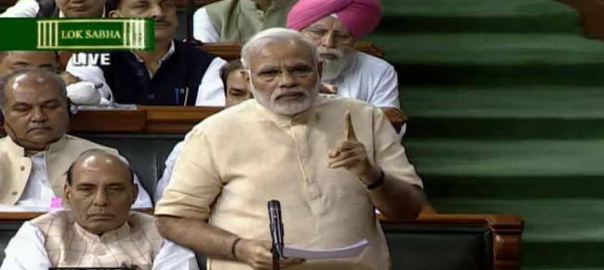
In a discussion in the Lok Sabha on Monday, Congress leader Mallikarjun Kharge said, “Those who are passing the GST now, why were they opposing it when they were in the opposition?

“I had many doubts. I had discussed it with Pranab Mukherjee many times,” PM Modi said in his speech during the discussion, referring to the President who was then Finance Minister in the UPA government.

“As Prime Minister, having the experience of a Chief Minister, I could easily address the concerns on GST,” PM Modi said.

He said there was a crucial need to develop confidence among states on GST as many of them had apprehensions over the centre compensating them for loss of revenue. Because GST is applied at the time of consumption, producing states like Tamil Nadu and Gujarat fear they will rack up losses. In both the Lok Sabha and Rajya Sabha, Tamil Nadu’s ruling party, the AIADMK, staged a walk out in protest before the vote on GST.

On Monday evening, after the six-hour debate, theLok Sabha unanimously voted in favour of the constitutional amendment bill that enables GST, a single national tax that will replace a raft of different state and local taxes.
The Prime Minister noted that a “lot of flaws have been overcome” in the provisions of GST, detailing how it will benefit states, and said he alone could not take credit for that, thanking parties for their support to enable what has been described as his biggest victory since the 2014 election.

One party had “birthed GST and another brought it up,” the PM said, emphasising that GST “can’t be seen as a victory of a party or government, it is a win for the democratic ethos of India and a victory for everyone.”

After the vote, the PM walked up to opposition leaders and shook hands with them.

Attack Me, Shoot Me, Not Dalits’: PM Modi’s Message In Hyderabad

Prime Minister Narendra Modi sent out a hard-hitting message today, calling for the protection of Dalits and punishment for fake cow protectors — issues over which his party, the BJP, has been facing opposition fire.
During his first visit to Telangana, he asked people to stop politics over Dalits, asking people to protect Dalits and other exploited sections. “If you have a problem, if you feel like attacking someone, attack me, not my Dalit brothers. If you want to shoot anyone, shoot me, not my Dalit brothers,” he declared.

“What is the reason we torture our Dalit brothers? What right do you have? The section which has suffered for centuries, will you force them to suffer more?” he further said.
The Prime Minister was speaking in Hyderabad, the home of Dalit scholar Rohith Vemula, who committed suicide on January 17, triggering an agitation at the University which spread to other campuses in the country.

Earlier, at Medak, he made some scathing comments about “fake cow protectors” saying they were “dividing the nation and should be isolated and punished”.

“Be wary of ‘nakli’ (fake) gau rakshaks, they have nothing to do with cow. Governments should crack down on them,” PM Modi said at a function to lay water pipes in Medak’s Gajwel.

 BJP legislator Raja Singh – who had controversially commented that Dalits flogged in Una would have had to “face such consequences” if they indulged in cow slaughter – was kept out of the scene. While all state BJP leaders, MPs, legislators, and Union ministers shared the stage with PM Modi in Hyderabad’s LB Stadium, Mr Singh was seated with the audience.

“The Prime Minister has made the party’s stand clear and I humbly accept it,” Mr Singh said.

This was the second time in two days the Prime Minister has called cow vigilantes to order. Yesterday, he delivered a blistering condemnation of cow protectors, saying they make him “so angry”.

Cow vigilantes have been blamed for some of the most outrageous incidents over the recent months, including the stripping and flogging of four Dalit men in Gujarat’s Una.

The incident provoked a huge protest by Dalits in Gujarat, a BJP bastion where opposition was quick to gain mileage, alleging that the ruling party was encouraging, or ignoring, the atrocities on the underprivileged.