


“Tamil Nadu is concerned about the impact the proposed GST will have on the fiscal autonomy of states and huge permanent revenue loss it is likely to cause to a manufacturing and net exporting state like Tamil Nadu.”
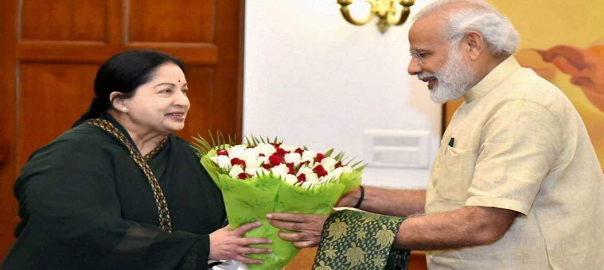
Tamil Nadu Chief Minister J Jayalalithaa on Tuesday met Prime Minister Narendra Modi in their first meeting after she retained power last month and told him that she still has “a number of concerns” on the GST Bill. She urged the Centre to “strive for a broad consensus on important issues” before the Constitution amendment Bill is taken up to address “genuine apprehensions” of states.
The Tamil Nadu Chief Minister wanted consensus on “compensation period and methodology, revenue neutral rates, floor rates with hands, commodities to be excluded from GST, the IGST (Integrated Goods and Services Tax) model and clarity on dual administrative control so that the genuine apprehensions of states regarding loss of fiscal autonomy and permanent revenue loss are allayed.”
Jayalalithaa handed over a 96-page memorandum to the Prime Minister, listing out the state’s demands and views on important topics. She wanted the Centre to support the Tamil Nadu government’s stand in the Supreme Court seeking the lifting of its stay on the bull taming sport Jallikattu. She wanted the Environment Ministry to “denotify bulls as performing animals” and amend section 11(3) of the Prevention of Cruelty to Animals Act, 1960 to exempt Jallikattu.
Watch Video:
Besides, she wanted the Government to constitute the Cauvery Management Board and Cauvery Water Regulation Committee, expedite wildlife and environment clearances to pave the way for restoration of water level in the Mullaperiyar dam to 152 feet, retrieval of Katchatheevu from Sri Lanka and restoration of traditional fishing rights of Tamil Nadu fishermen and early commissioning of Unit II of Kudankulam nuclear power plant.
On GST, the memorandum said: “Tamil Nadu is concerned about the impact the proposed GST will have on the fiscal autonomy of states and huge permanent revenue loss it is likely to cause to a manufacturing and net exporting state like Tamil Nadu.”
“There should be a constitutionally mandated independent compensation mechanism for full (100 per cent) compensation of revenue losses suffered by the states for a period of not less than five years.”
She told the Prime Minister that the state is happy that the Centre has addressed “some of the concerns” raised by it and has removed the provision of declared goods which was against the principle of harmonisation, kept alcohol outside the purview of GST and dropped the provisions relating to the advisory committees for dispute resolution.
“However, a number of concerns of Tamil Nadu still need to be addressed…GST Council as a constitutional body impinges on the legislative sovereignty of both the Parliament and the State Legislatures and completely jeopardises the autonomy of states in fiscal matters…We strongly object to the provision for the GST council,” it said. She favoured continuation of the existing mechanism of Empowered Committee of State Ministers which dealt with VAT. “Ideally, no statutory GST Council is required.”
Besides, it said the “decision-making rule and voting weightage in the proposed Council are unacceptable.”
“They give the Government of India an effective veto in the GST council and no distinction is sought to be made amongst the states in weightage. Hence, if at all the Council is formed, the weightage of the vote of the Central Government should be reduced to one-fourth of the total votes cast and that of the State correspondingly increased to three-fourths….Further, the weightage of each state’s vote should be in proportion to the representation of the state in the Rajya Sabha,” she said.
Besides, petroleum and petroleum products must be kept outside GST permanently “in view of the revenue impact and the positive environmental and social impact of high effective taxation on these items.” States should be enabled to levy higher taxes on tobacco and tobacco products on par with the Centre.
She said in lieu of the proposed additional levy of 1 per cent tax on inter-state supply of goods, “origin states may be allowed to retain 4 per cent of the central GST part of the inter-state GST that would be leviable on inter-state supply of goods and services as this would ensure speedy recompense for a portion of the revenue loss and will reduce the amount of compensation payable.”
“Further, as this comes out the GST component, it does not affect the destination state’s revenue or cause any cascading,” it said.
